
Chlorine Generators
Is Salt Water Corrosion a Problem for You?
If you are considering putting in a pool, there are a few options to handle less chlorine. One such option is the salt water pool. However, if you are thinking about a salt water system, it is important to understand that there may be some salt water pool corrosion problems, especially if you try to convert a current chlorinated system to a salt water system. Before you choose a pool, make sure you understand when and how you should expect salt water pool corrosion from any chlorine generator.
Pictured below - Actual damage to customer's pool after one year of using a salt water pool system
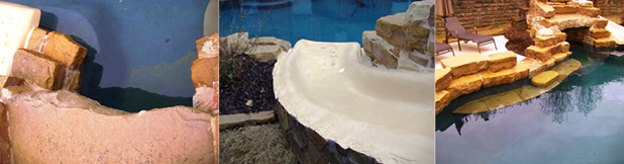
Salt water pool corrosion can also be a problem on parts of the pool you can see, which will not actually hurt the pool, but which will cause cosmetic issues. You probably spent $35,000 or more on your pool, we would like to see your cement last ten years or more. Cosmetic salt water pool corrosion is most common on the metal stairs and handrails found in some pools. Luckily, this problem can be cleared up quite easily. Clean the metal (out of water) and dry it to remove any salt water pool corrosion already built up. Then, use a sealant to help you avoid more salt water pool corrosion in the future. This should take care of the problem, but be aware that there high costs associated with some kinds of sealant.
Even if salt water pool corrosion is not a huge problem for you, don't be fooled into thinking that your salt water pool is safe and chemical free! Salt water pool systems generate chlorine, as well as other chemicals. Backsplash from this pool water can kill vegetation around the pool and can cause soil and water problems with the ecosystem. In addition, the salt water pool system, if not regulated, can cause your chemicals to fluctuate, making it an unhealthy option for swimmers. Natural pools are a much better option, as they are not as harsh on your pool or your body.
The bottom line if you are spending money on a device, ECOsmarte eliminates all of the chlorine and all of the equipment corrosion and concrete pitting.